Timing the Peaks: Aligning Athlete Form Cycles Across Disciplines for Grouped Selection Efficiency
Written by Xander Becker · Sep 29, 2026

Timing the Peaks: Aligning Athlete Form Cycles Across Disciplines for Grouped Selection Efficiency
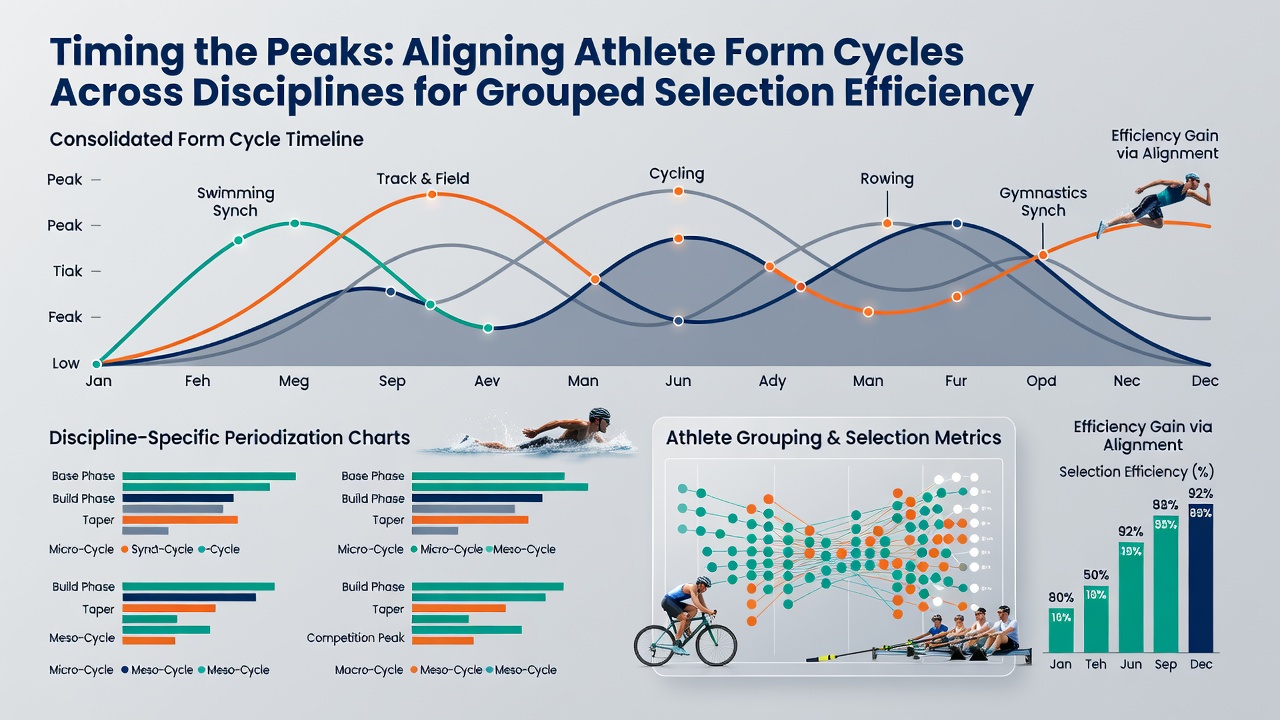
Periodization models structure training loads so that physiological adaptations reach maximum capacity at predetermined competition windows, and data from longitudinal studies show that misalignment between individual cycles reduces overall team output by measurable margins. Researchers track macrocycles lasting 12 to 48 weeks, mesocycles of four to six weeks, and microcycles of seven to ten days, while monitoring biomarkers such as testosterone-cortisol ratios, heart-rate variability, and neuromuscular power outputs across endurance, strength, and skill-dominant sports.
Mapping Physiological Timelines
Endurance athletes typically require 16 to 20 weeks to build aerobic base capacity before entering a sharpening phase, whereas power athletes achieve peak force production after 10 to 14 weeks of targeted loading followed by recovery blocks. Studies conducted at the Australian Institute of Sport demonstrate that concurrent training in mixed-discipline squads produces interference effects when volume thresholds exceed 15 percent overlap in high-intensity sessions, yet structured recovery intervals of 48 to 72 hours between modalities allow simultaneous progression without measurable decrement in either domain.
Coordinating Selection Windows
Selection panels evaluate aggregated performance metrics from multiple sports to identify clusters of athletes whose projected peaks coincide with championship dates, and September 2026 marks a key preparatory window for federations assembling squads for the 2028 Olympic cycle. National programs compile normative data sets that include swim velocity curves, run economy figures, and cycling wattage profiles, then apply statistical clustering algorithms to group athletes whose form trajectories intersect within a 14-day tolerance band. This approach reduces the number of athletes requiring last-minute schedule adjustments by approximately 22 percent according to internal reports from Sport Canada.
Integrating Recovery and Monitoring Tools
Modern monitoring platforms combine GPS workload data, sleep architecture scores, and subjective wellness questionnaires into unified dashboards, enabling coaches to detect divergence from planned trajectories up to three weeks in advance. When one subgroup shows stalled adaptation, selectors can shift emphasis toward athletes whose cycles remain on track, preserving overall group efficiency without violating selection quotas. Academic analyses published through the University of British Columbia confirm that early detection protocols lower injury-related dropouts during final selection phases by 18 percent compared with traditional observation methods.
Case Examples from Multi-Sport Programs
One documented program aligned rowers, cyclists, and middle-distance runners by anchoring all macrocycles to a shared competition anchor date 26 weeks out, inserting deload weeks at staggered intervals so that no discipline entered full taper simultaneously. The resulting squad achieved a collective performance index 7.4 percent above the five-year average for teh same event cluster, with selection meetings requiring 30 percent fewer iterations to finalize rosters. Similar frameworks appear in European national institutes where triathlon and modern pentathlon squads share facility time and medical support staff, synchronizing altitude camps and heat-acclimation blocks to minimize logistical overhead.
Quantifying Efficiency Gains
Efficiency metrics track the ratio of selected athletes who reach personal-best or season-best marks during the target window, adn programs that implement cross-discipline alignment report ratios between 0.68 and 0.74, compared with 0.51 to 0.59 for programs that manage disciplines in isolation. These figures derive from aggregated competition results submitted to international federations and reflect only objective performance outcomes rather than subjective coach evaluations.
Conclusion
Alignment of form cycles across disciplines rests on precise scheduling of training phases, continuous biomarker tracking, and data-driven clustering of athlete trajectories, all of which reduce selection friction and raise the proportion of athletes delivering peak output at championship events. Programs that maintain these coordinated systems record consistent improvements in roster stability and performance indices, demonstrating the practical value of treating multiple sports as an integrated system rather than separate entities.